
Consulting Pricing Models and What Each One Signals

Michel Fortin
Author
Article Summary
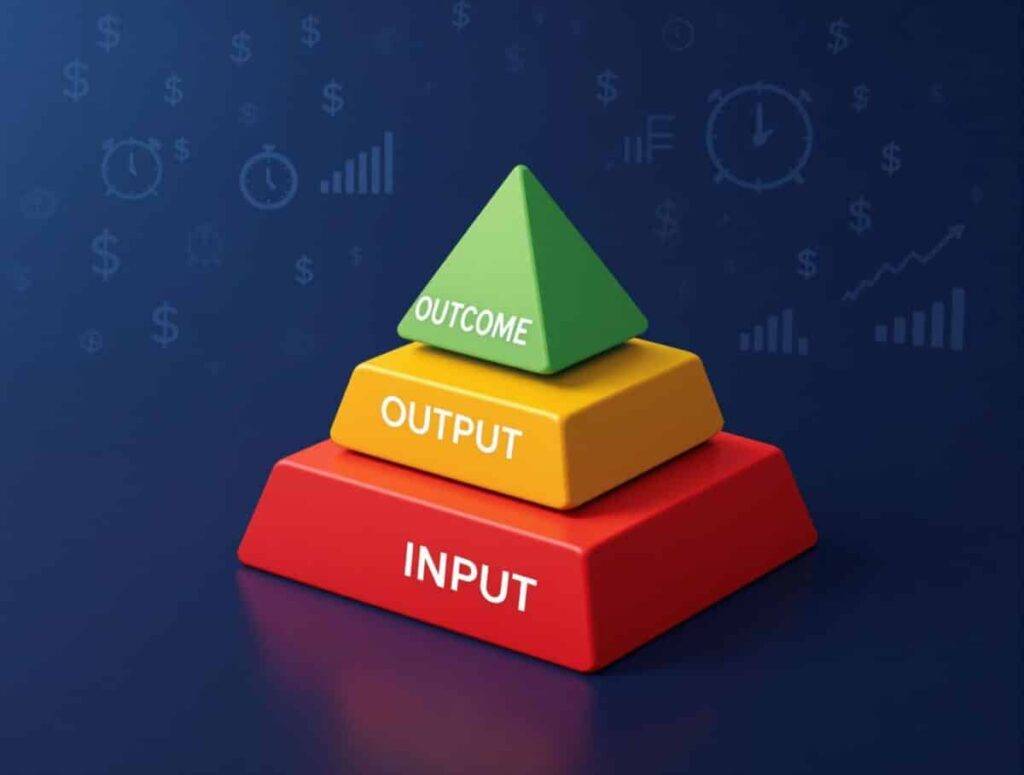
Consultants price their work in three ways. Input-based pricing charges for time, output-based pricing charges for deliverables, and outcome-based pricing (often called value-based pricing) charges for results. Each model shifts risk and incentives between the buyer and the consultant. This article compares the three, explains why a named, tiered package signals strategic maturity, and makes the case for a paid discovery phase before any large engagement.
In the late nineties, I priced my copywriting work by the hour. A client would ask for a campaign, I’d estimate the hours, multiply by my rate, and send the invoice. Simple and honest. And every client relationship ended up being about the timesheet.
Buyers shaved hours off the research phase. They asked whether the second revision was necessary. They wanted to know what would happen if I came in under budget. The conversation never landed on the work.
So I stopped pricing the time and started pricing the delivery. One sales letter, one price. The negotiation moved with it, and buyers started asking what was inside the package instead of how long it would take.
That shift taught me something I still use. The way a consultant prices their work tells you more about how they think than any resume will. It shows where they place risk, where their incentives sit, and whether their interests line up with yours.
Consultants price their work in three ways. Input-based means you pay for time. Output-based means you pay for deliverables. Outcome-based means you pay for results.
The Three Consulting Pricing Models
Every consulting pricing model I’ve seen, from solo advisors to management consulting firms, falls into one of three categories. Here’s how they compare.
| Model | Also Called | You Pay For | Risk Sits With | Consultant’s Incentive | When It Fits |
|---|---|---|---|---|---|
| Input-based | Hourly, daily rate, time and materials, retainer | Time | You | Extend the engagement | Scope is unclear or advisory is ongoing |
| Output-based | Fixed-fee, project-based, deliverables-based | Deliverables (audit, roadmap, set of sessions) | The consultant | Deliver efficiently | Scope is defined and outputs are specific |
| Outcome-based | Value-based, performance-based, success fee | Results (% of value created, performance fee) | Shared | Move to the result fast | Value is measurable and agreed on |
The fee ranges below come from my own experience. I’ve worked as an independent consultant for most of my career, and I’ve worked alongside management consultants, strategy consultants, IT engineers, and plenty of other advisors.
Input-based pricing
Input-based pricing means you pay for time. Hours, days, or monthly retainers billed against effort. It’s the default for lawyers, accountants, designers, and plenty of consultants. Senior strategist hourly rates typically run $200 to $500, and full retainers for experienced advisors fall between $5,000 and $25,000 per month.
It’s easy to understand and easy to justify internally. But it has a structural problem. Input pricing punishes the consultant for being efficient. The faster they solve your problem, the less they earn.
That’s the trap I started in. Scope creep and extended timelines work in the consultant’s favor, not yours, and experienced buyers know it.
Output-based pricing
Output-based pricing means you pay for deliverables. A completed audit, a strategic roadmap, a restructured funnel, a defined set of coaching sessions. The fee is tied to what gets produced, not how long it takes to produce it. Some consultants call this deliverables-based pricing or fixed-fee pricing. Same model, different label.
Mid-market output-based projects usually range from $10,000 to $75,000, with discovery or audit phases priced between $5,000 and $15,000. The risk profile beats input pricing. If the project runs longer than expected, that’s the consultant’s problem, not yours.
It’s also where the incentive flips. Efficiency now protects the consultant’s margin instead of eroding it. Most sophisticated consultancies, agencies, and fractional executives price this way, and it’s where packaging starts to matter, which I’ll get to in a moment.
Outcome-based pricing
Outcome-based pricing means you pay for results. Most people call it value-based pricing. The fee is anchored to the value created or the impact delivered, not the time spent or the deliverables produced. Typical structures run 10% to 30% of the quantified value, sometimes blended with a reduced base retainer to share the risk.
This is the most powerful model for the buyer, and the most revealing about the consultant. When someone prices on outcomes, they’re telling you three things. They’re confident they can produce results. They’ve done this enough times to forecast value accurately. And they’re willing to put their own compensation on the line.
My own practice blends the two. The Gauge, my diagnostic audit, is output-based. It’s a packaged deliverable, and the price moves with the scope. The Anchor and The Vector are priced largely on the value of the outcome they produce, so they sit somewhere between output and outcome.
Why Outcome Pricing Produces Better Engagements
When a consultant’s fee is tied to the outcome, the whole engagement dynamic shifts.
The consultant becomes a partner with skin in the game. Their incentive isn’t to stretch the engagement or pad deliverables. It’s to get you to the result as efficiently as possible. That alignment shows up in faster decisions, more candid advice, and less politics.
Here’s a pattern I see often in cost-efficiency work. A consultant audits procurement processes, renegotiates vendor contracts, and eliminates supply chain redundancies. On a $1,000,000 annual operational budget, a 15% cost reduction saves the client $150,000. The consultant’s fee is a fraction of that savings.
But the value compounds beyond the first-order number. That $150,000 might fund a new hire, increase the marketing budget, or improve financial health enough to attract investors. A good outcome-priced consultant helps you see those downstream effects and structures the engagement around them.
The key question when you’re evaluating outcome pricing is whether the consultant can clearly articulate what “value” means in your specific context. If they can quantify it, forecast it, or point to a track record of producing it, the model works. If the value is vague or speculative, an output-based model with a discovery phase is the safer place to start.
Why the package is the position
Here’s the part most firms skip. For a service business, the package is where the positioning lives.
A product company carries its position in the thing on the shelf. A service firm carries it in the shape of the offer: what’s included, what isn’t, who it’s for, and what it’s worth. A buyer who reads your package reads your strategy. A buyer who reads a list of hourly rates reads your hourly rates.
Without a package, three things break. Your price gets compared to every other practitioner’s hourly rate. Your capacity stays chained to your calendar. And there’s nothing to hand off to a junior or to AI, because the only thing you sell is your own hour.
That’s why I treat productization as a positioning move, not a pricing tactic. It’s Power Positioning applied to the offer itself.
How I bundle and name a package
When I sold long-form sales letters, the fixed price covered four named stages. An audit of what the client already had. Research into the product, the market, the competition, and the proof. A full first draft. Then a final draft, with two rounds of revisions named explicitly. Anything past the second revision became its own engagement.
That structure did three jobs. It made the price comparable to other packages instead of other hourly rates. It made the scope visible, so nobody suspected I was leaving things off the page. And it took line items off the negotiating table, because the package was the package.
Then something happened I didn’t expect. Buyers started asking for the bigger version. Once the shape was visible, the question wasn’t whether to buy. It was which version.
A name finishes the job. A package without a name is a list of deliverables. A package with a name is something a buyer can ask for, remember, and refer to someone else. Mine are The Gauge, The Session, The Anchor, and The Vector. When a buyer asks for The Gauge by name, they’re doing positioning work for me.
What Tiered Pricing Signals About a Consultant
The best proposals give you three options. Not one. Not five. Three.
After a discovery phase, a sophisticated consultant typically presents three tiers. Some call them low, medium, and high. Others use bronze, silver, and gold. I call that Olympic-Factor Pricing, an analogy I’ve used since my first books on Power Positioning in the late 1990s and early 2000s. The scope, depth, and price point differ across the tiers, but each one is fully scoped and ready to execute.
In my own fractional executive practice, every proposal I send follows this structure. It came from years of watching how buyers actually decide. When you offer three options, the buyer moves from “should I hire this consultant” to “which version of this engagement is right for us.” That’s a different conversation, and a far more productive one.
One rule I hold to. The tiers should differ in scope, depth, or scale, not in quality. A bronze tier that delivers worse work than gold isn’t a tier. It’s a warning.
Tiered pricing does three things for you as the buyer.
It gives you real choice without negotiation theater. You can match the engagement to your growth stage, your budget, and your urgency. It creates natural upgrade paths, so you can start with a diagnostic tier and move into a full engagement once both sides have validated the fit. And it lets you walk away from a tier without walking away from the consultant.
It also tells you something about the consultant. Building three fully scoped tiers takes real thought about service delivery, client segmentation, and the different levels of value that are actually possible. Someone who thinks that carefully about their own business will usually think that carefully about yours, which is the whole point of hiring them.
If a consultant hands you a single price with no alternatives, ask for tiers. Their answer will tell you how carefully they’ve thought about how you actually need to engage.
The Discovery Phase as a Risk Reducer
Whatever the pricing model, the best engagements start with a bounded discovery phase. An audit, assessment, or roadmapping engagement, scoped and priced as a standalone deliverable.
In my practice, that phase is The Gauge, a diagnostic I run with nearly every client before I recommend anything else. I use the PULSE Diagnostic to find where growth has stalled, then build the roadmap from what it reveals.
For you as the buyer, this cuts risk dramatically. Instead of committing to a six-figure engagement based on a sales conversation, you invest in a diagnostic phase that gives both sides clarity. You see how the consultant thinks, how they communicate, and whether their diagnosis matches your reality.
For outcome-priced engagements especially, discovery is where the consultant establishes the value baseline. It’s where they assess what results are realistic, what the engagement is worth, and whether the opportunity is a genuine fit. Without that baseline, outcome pricing is guesswork on both sides.
If a consultant skips straight to a large proposal without offering a discovery phase, push back. It usually signals overconfidence or a one-size-fits-all practice. Either way, ask for a smaller paid engagement first so both sides can validate the fit before you scale the commitment.
How packaging lets a firm scale
A package does one more thing hourly billing can’t. It separates the work from the person delivering it.
Think about how a lawyer runs a case. The lawyer stands up in court, but the brief was prepared with help. Paralegals pull the research, and juniors trained on the lawyer’s thinking draft parts of it. The client is buying the lawyer’s judgment, and the hours behind it are leveraged hours.
I built my early copywriting practice the same way. Juniors trained on my frameworks started with research, then moved into first drafts that I shaped. Clients bought the package, and the practice delivered it.
AI is the modern paralegal. It pulls research, drafts at speed, and surfaces patterns, while the frameworks and the judgment stay mine. That only works when the work has a defined shape. No package, nothing for the leverage to attach to. It’s the same reason I use AI as an amplifier and not a replacement.
Which is why output and outcome pricing suit a leveraged firm so well. The buyer isn’t paying for hours or resources. They’re paying for the result. How the result gets produced is the firm’s problem, and a firm that has solved it delivers faster and at a better margin.
Why Published Pricing Logic Is a Good Sign
Some consultants explain how they price in public, on their site or in articles. I count that as a good sign, because a consultant who shows their pricing logic before the first call is comfortable with you seeing where the risk sits.
It matters even more now that buyers ask AI first. When someone asks ChatGPT what a fractional CMO costs, it can only draw on firms that answered the question somewhere. The consultant who answers it openly is easier to find, and easier to vet, than one who makes you book a call to learn anything. I explain the mechanics in my post on how I run an AI visibility audit.
How to Evaluate a Consultant’s Pricing
When you’re comparing consultants, the pricing strategy reveals more than the price itself. The model a consultant chooses tells you how they think about risk, incentives, and your outcome. Six questions to run through.
- Is the consultant incentivized to solve your problem quickly, or to extend the engagement?
- Does the fee structure reward efficiency and results, or time and activity?
- Are they willing to put some of their compensation at risk against the outcome?
- Have they offered a bounded discovery phase, or are they asking for a large commitment upfront?
- Did they give you three tiered options, or a single take-it-or-leave-it number?
- Is the offer a named package with a clear scope, or a list of hourly line items?
The best consulting engagements aren’t defined by the lowest fee. They’re defined by the clearest alignment between what you pay and what you get.
That alignment is part of a broader growth system. A consultant who prices on outcomes, offers a structured discovery phase, and presents three tiered options is telling you through their commercial model that they’re confident in their work and willing to prove it before you scale the commitment. That’s the kind of authority-driven positioning that separates strategic partners from vendors.
Are You Ready For Your Next Step?
If you’re evaluating a consultant and want a second opinion on their pricing structure, book The Session, my one-on-one strategy call. I’ll review the proposal with you, tell you what their pricing model signals about how they’ll actually work, and help you structure an engagement that lines up with the outcome you actually want.
Frequently Asked Questions
How much do consultants charge?
Fees vary by pricing model and seniority. Senior strategist hourly rates typically run $200 to $500. Monthly retainers for experienced advisors fall between $5,000 and $25,000. Output-based projects for mid-market engagements usually price between $10,000 and $75,000, with discovery or audit phases at $5,000 to $15,000. Outcome-based fees are commonly 10% to 30% of quantified value, sometimes blended with a reduced retainer.
What’s the difference between input-based, output-based, and outcome-based pricing?
Input-based pricing charges for time, like hourly rates or retainers. Output-based pricing charges for defined deliverables, like an audit or a project roadmap. Outcome-based pricing charges for results, typically as a percentage of value created or a performance fee. Each model shifts risk and incentives differently between the buyer and the consultant.
What is value-based pricing in consulting?
Value-based pricing, often called outcome-based pricing, ties the consultant’s fee to the measurable results they produce. Instead of paying for hours or deliverables, you pay for the impact created. It works best when value can be quantified clearly and both sides agree on how it’s measured, usually after a discovery phase.
Should I hire a consultant on a retainer or project basis?
Retainers fit when you need ongoing advisory, flexibility, or a long horizon of decisions. Project-based pricing fits when you have a defined scope and a specific deliverable. If the scope is vague, start with a discovery phase rather than committing to either structure upfront. The structure should follow the work, not the other way around.
What is a discovery phase in consulting and why does it matter?
A discovery phase is a short, paid engagement, typically $5,000 to $15,000 for mid-market work, where the consultant assesses your situation, validates their diagnosis, and recommends a path forward. It reduces risk for both sides. You see how the consultant thinks before committing to a larger engagement. They establish a realistic value baseline before pricing any outcome-based work.
Is outcome-based pricing always the best choice?
No. Outcome-based pricing works when value is measurable, both sides agree on the metric, and the consultant has a track record of producing that outcome. When value is vague or hard to measure, output-based pricing with a discovery phase is usually a better starting point. The best pricing model is the one that aligns incentives for your specific engagement.
What does tiered pricing tell me about a consultant?
A consultant who presents three tiered options (low, medium, high or bronze, silver, gold) has thought carefully about how buyers actually engage. It signals strategic maturity, clarity about service delivery, and an understanding of client segmentation. A single take-it-or-leave-it price often signals the opposite, a consultant who hasn’t thought carefully enough about how to match their work to your situation.
What is deliverables-based pricing in consulting?
Deliverables-based pricing is another name for output-based pricing. You pay a fixed fee for a defined deliverable, such as an audit, a strategic roadmap, or a set number of sessions, rather than paying for the consultant’s time. The risk of overruns sits with the consultant, which makes it a safer structure than hourly billing when the scope is clear.
How do I compare pricing across different consulting firms?
Compare the model before the number. Ask each firm where the risk sits, whether the fee rewards results or activity, and whether they offer a bounded discovery phase before a large commitment. A lower hourly rate with an incentive to extend the engagement often costs more than a higher fixed fee tied to a defined outcome. Tiered proposals also make comparison easier because you can match scope to scope instead of guessing.
What is productized consulting?
Productized consulting packages a service into a named, fixed-scope offer with a set price, instead of selling hours. The package defines what’s included, what isn’t, and what it costs. Buyers compare it to other packages rather than to hourly rates, and the firm can deliver it through trained staff or AI, not only the founder.
What is Olympic-factor pricing?
Olympic-factor pricing is Michel Fortin’s name for presenting three fully scoped tiers, such as bronze, silver, and gold. The tiers differ in scope, depth, or scale, not in quality. Three tiers shift the buyer’s question from whether to hire the consultant to which version of the engagement fits.
How should a consultant package their services?
Start with a defined deliverable and break it into named stages, such as audit, research, draft, and final, with a set number of revisions. Give the package a name buyers can ask for. Offer it in three tiers that differ in scope, not quality, and put a paid discovery phase in front of larger engagements.

Michel Fortin
Michel Fortin is the creator of Power Positioning and a fractional CMO/CGO/CSO who helps growth-stage companies, expert-led firms, and SaaS brands diagnose what's stalling their organic growth and build the systems to fix it. Over 35 years and more than 200 industries, his work has influenced over $3 billion in revenue by combining deep positioning expertise with AI-powered marketing strategy. He's the author of Power Positioning and a recognized thought leader on organic visibility and authority-driven growth. Michel writes the Fortin File™ Newsletter (on Substack), where he shares strategic insights on positioning, AI, and sustainable growth for leaders and consultants.

UPWORDS started as a copywriting technique in 1998. Today I use it to write content buyers can picture and AI can quote, because the words that help people understand you help machines cite you.

The numbers belong to the engagements that produced them. Here’s what I found in each one, what I changed, and the frameworks that carried the work, from AI visibility to agency restructures.

When buyers ask AI to recommend a consultant, who gets named? I ran 468 answers across five AI engines to find out. The big names win in strategy, and the firms that break through publish the pages AI cites.