
The AI Shortlist Study

Michel Fortin
Author

Article Summary
The AI Shortlist Study tracks which firms AI assistants name when a buyer asks for a consultant or a search firm. The Q4 2026 round asked 36 buyer questions across three categories (marketing consultants, executive search firms and strategy consultants) to ChatGPT, Claude, Gemini and Perplexity three times each, plus Google AI Overviews once, for 468 answers in total.
Large global firms dominated strategy and much of executive search, while marketing answers were scattered and leaned toward agencies. Most cited sources were firm and vendor websites rather than independent media. The boutiques AI named most often had published pages that matched specific buyer situations. Engines agreed on few names, and answers changed between runs. Of 30 randomly drawn boutiques, two were named once each.
Why I ran this study
My clients keep asking me the same question. “When someone asks ChatGPT for a firm like ours, do we show up?” A recent client asked me almost exactly that when they hired me. Usually the answer is no, and the next question is why.
I could have answered with a hunch. Instead, I wanted data I collected myself, with the questions, the method and the raw answers on the record. So I wrote 36 questions the way a real buyer would type them, ran them through five AI engines, and coded every answer.
I’m a marketing advisor, so I put marketing consultants in the study, which means I’m in it too. I’ll show you my result, and it isn’t flattering.
What I asked, and where
I picked three fields where buyers hire experts and where small, expert-led firms compete with big brands: marketing consultants, executive search firms and strategy consultants.
Each field got 12 questions, written in the buyer’s voice. Some were broad (“Who are the best marketing consultants for a B2B professional services firm?”). Some were specific (“We need a CEO successor for a family-owned manufacturing company. Which search firms should we consider?”).
I asked each question to ChatGPT, Claude, Gemini and Perplexity three times, on October 12, 14 and 16, 2026, with web search turned on. That’s 432 answers. I then captured Google’s AI Overview for all 36 questions, signed out, for another 36. The full method is at the end of this page.
Finding 1: In strategy and executive search, the big names come first
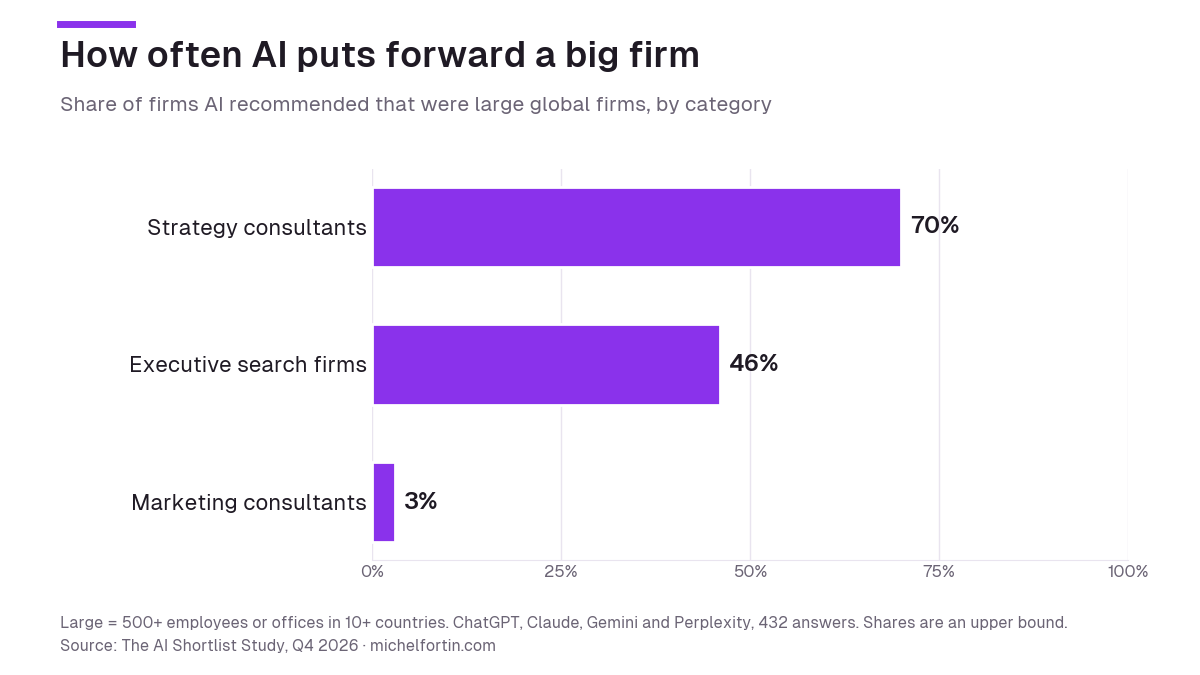
Ask AI for a strategy consultant and you’ll usually get McKinsey, BCG, Bain, the Big Four and the next tier of global firms. Large firms appeared in 86% of strategy answers and took 70% of the names in strategy answers. In 72% of answers, the first firm named was a large one.
Even asking for something cheaper didn’t change much. When a buyer said they couldn’t afford McKinsey, 12 of 12 answers still led with a large firm, and 10 of those led with L.E.K. Consulting. To AI, the alternative to a global firm is another global firm.
Executive search was more open. Korn Ferry, Spencer Stuart, Russell Reynolds, Heidrick & Struggles and Egon Zehnder each showed up in roughly half or more of the answers. But boutiques held their own, and when a buyer asked for firms “that aren’t the big global names,” every answer led with a smaller firm.
Finding 2: Marketing answers are scattered and agency-shaped
Marketing looked nothing like strategy. No single name appeared in even a quarter of the answers. The most-named were Directive (23% of answers), Kalungi (22%), Chief Outsiders (19%) and April Dunford (16%).
The bigger pattern is who gets named. I asked about marketing consultants, and AI answered mostly with agencies. Agencies took about four in ten of the names in marketing answers. Independent consultants were named in 40% of answers, and most of them were famous authors and speakers.
When a question asked outright for “independent consultants, not agencies,” individuals appeared in 12 of 12 answers. So the engines can find independent experts. They just don’t default to them.
Finding 3: Firms get named on other people’s pages
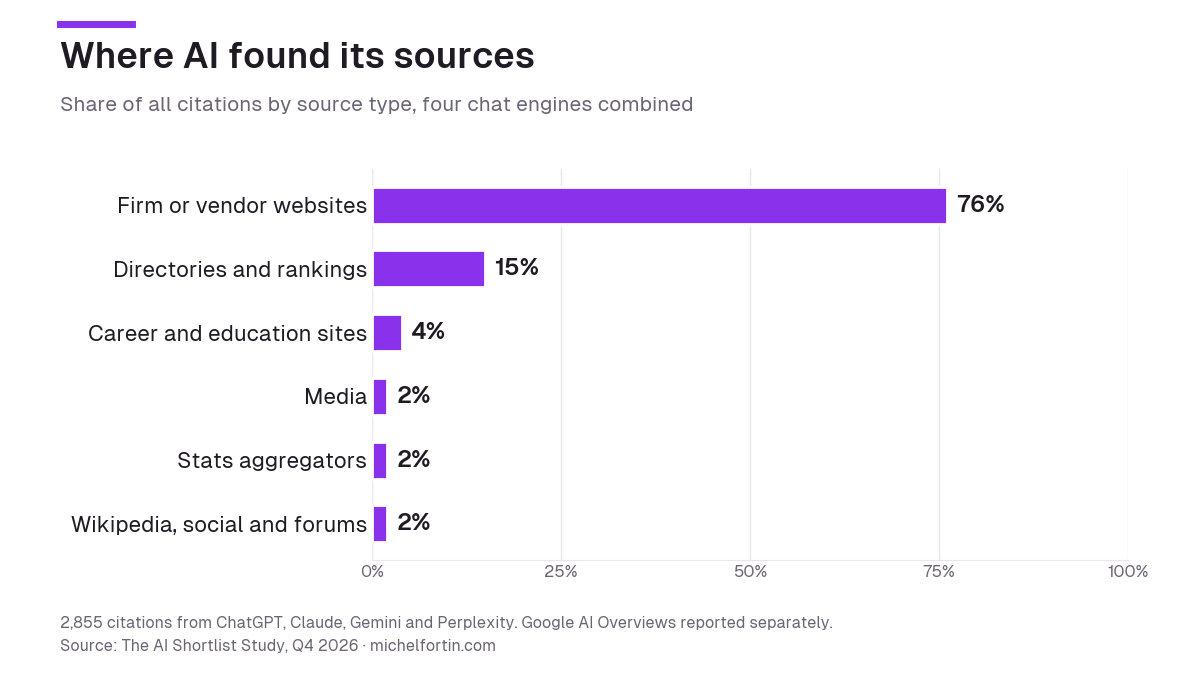
I expected AI to lean on third party sources like media, directories and forums. It didn’t. About three in four citations pointed to a firm or vendor website.
But mostly not the named firm’s own site. In marketing, only 18% of those vendor citations belonged to the firm being recommended. The rest came from other firms’ blog posts and “best of” lists. In practice, a firm got named because someone else wrote about it.
Strategy had a twist I didn’t see coming. One in eight of its sources were case-interview and career sites, the kind written for MBA students who want jobs at McKinsey. A CEO asks for strategy help, and AI builds the shortlist from content about where to work. That likely explains why strategy answers default to the famous employers.
Media sites made up about 2% of citations from the four chat engines. Reddit, LinkedIn, YouTube and Wikipedia combined made up another 2%. Google was different, and I’ll come back to that.
Finding 4: The boutiques that break through publish the page AI cites
A handful of boutique search firms showed up again and again. Cowen Partners was named in nearly half of all executive search answers, and in 8 of Google’s 12. Talentfoot and Christian & Timbers weren’t far behind.
When AI named them, it usually cited their own website. Talentfoot’s own site was cited in 42 of the 44 answers that named it. Cowen’s was cited in 42 of 67, and Christian & Timbers’ in 34 of 42.
They got there in two different ways. Talentfoot and Christian & Timbers publish “top search firms” lists by niche, such as CMOs, COOs, healthcare and manufacturing. Cowen publishes one service page per buyer situation, such as CFO search, family business succession and healthcare leadership. Either way, there’s a page that answers the exact question a buyer types.
That lines up with what I check in an AI visibility audit, which checks four pathways to AI citation I call the Four Doors. The first door is the sources others publish about you. The second is the sources you publish yourself. The firms that win here built the second door on purpose.
Finding 5: Self-published lists help their authors less than you’d think
Plenty of firms publish their own “best firms” list and include themselves. I wanted to know whether AI rewards the author when it cites that list.
It depends on the engine. When a self-published list was cited, the author was also named 52% of the time in ChatGPT, 33% in Gemini, 30% in Claude, 29% in Google and 16% in Perplexity. Most of the time, the list helped the firms on it more than the firm that wrote it.
One marketing agency’s “21 strategic marketing consultants” post was cited 34 times. In 16 of those answers, its author wasn’t named. On one executive search question, Google cited a boutique’s list four times to recommend four big competitors, and never named the boutique.
Lily Ray found that Google’s AI Overviews leave the publishing brand out of its own self-ranked list 83% of the time. My numbers point the same way, a little less sharply on these questions. The lists that worked were narrow and specialized, which is the opposite of a generic “top 50.”
Finding 6: Every engine gives a different shortlist, and it changes every time
The engines rarely agreed. In marketing, 63% of the names came from one engine only. In strategy and executive search, it was about 40%. Of the 871 websites the four chat engines cited, 76% were used by just one of them.
Google stood apart too. More than a third of the names in Google’s answers didn’t appear in any other engine’s answers to the same question. Kevin Indig reported a similar split for citations in the first half of 2026. We measured it differently, but the direction is the same.
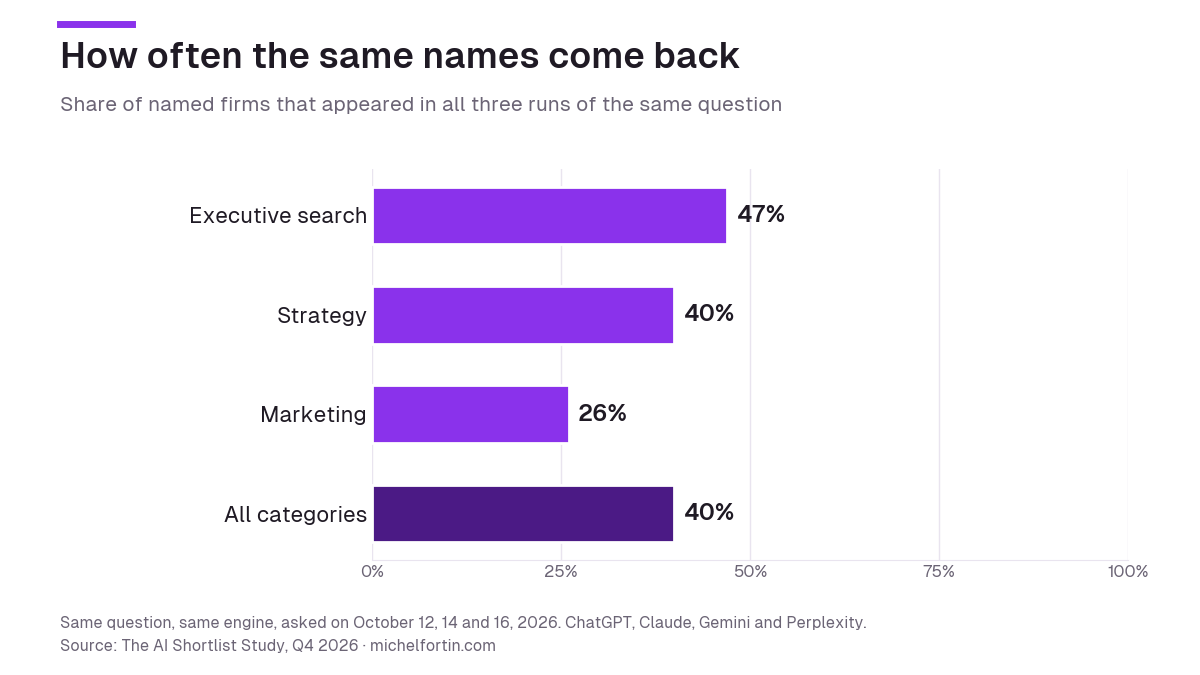
The answers also moved from run to run. Only 40% of the names reappeared in all three runs. The first name in an answer was the same across all three runs just 40% of the time. One of my Google captures reloaded by accident, and the new Overview swapped two of its six names.
A single check on a single engine tells you very little. That’s why I run every question more than once, across engines, before I draw a conclusion for a client.
Finding 7: The boutiques I tracked are nearly invisible, me included
Before the first run, I drew 30 expert-led boutiques at random, 10 per category, from public business directories. These are real firms with real principals doing the work, the kind of firm a mid-market buyer would be lucky to find.
Two of the 30 were named once each, both by ChatGPT, both in executive search. Google named none of them.
I scored all 30 on the Four Doors: what others publish about you, what you publish, the signals that confirm who you are, and how fully you cover your topic. The two named firms scored higher than most. But some high scorers weren’t named at all, so with two hits I can’t call it a pattern yet.
Now my own result. Across 468 answers, no engine named me. My site was cited once, as a source for a point about fractional chief strategy officers, without my name attached. I scored well on the pages I publish and the signals that confirm who I am. I scored lower on what others publish about me and on how fully my site covers the topic. The first of those is the door these results say matters most.
I’m sharing it anyway, because it’s also my to-do list.
What this means if you run an expert-led firm
First, stop checking once. AI answers shift between runs and differ by engine, so a single screenshot isn’t a baseline. Track a fixed set of buyer questions over time.
Second, earn mentions on other people’s pages. Most firms in this study got named through someone else’s list, article or directory. That’s the first of the Four Doors, the footprint AI draws from, and it’s where brand memory gets built.
Third, publish one page per buyer situation. The boutiques that broke through answered narrow questions completely, like “CFO search for a PE-backed company” or “COO search for a growing company.” Broad “we do everything” pages rarely got cited.
Fourth, be careful with self-ranked lists. They can work when they’re narrow and fair to the competitors listed. More often, they send buyers to someone else.
If you want to see where your own firm stands, this is the same work I do in The Gauge.
How I ran the study
Questions. 36 buyer questions, 12 per category, frozen before the first run and written so none favored any firm, including mine. One question per category asked about Canada; the rest were general.
Engines. ChatGPT (gpt-5.5), Claude (claude-sonnet-5-5), Gemini (served as gemini-3.6-flash) and Perplexity (sonar-pro), queried through the DataForSEO LLM Responses API with web search on. Three runs each, on October 12, 14 and 16, 2026, for 432 answers. The engines chose not to search on 28 of those answers; I kept them and flagged them.
Google AI Overviews. Captured once per question on October 18 and 20, 2026, signed out in a private window with US results requested. I recorded the first screen of each Overview, plus a second screen where the names sat below the fold. The searches ran from a Canadian connection, and Google detected Canada on at least one page.
Coding. I coded every firm or person named, using a dictionary of about 300 names, and counted a name as “put forward” when the answer listed it, bolded it or placed it in a table. That filters out passing mentions like “unlike Korn Ferry.” A firm counts as large with 500 or more employees or offices in 10 or more countries, based on LinkedIn and firm websites. A spot-check of 20 random answers found the coding caught about 86% of names; the ones it missed were small firms, so the large-firm shares are an upper bound.
Panel. 30 boutiques of 5 to 50 people, drawn at random with a fixed seed from RevenueBase city directories, plus me, disclosed. Panel results are reported in aggregate. Each firm can get its own results privately.
Limits. This is one snapshot in time, in US English, through API access that can differ from the consumer apps. Google has one run, not three. The panel is small. These are associations, not causes.
Disclosure. I sell AI visibility audits, and I’m in the marketing panel. Nobody commissioned or paid for this study. I’ll re-run the same questions each quarter and add each round to this page.
Frequently Asked Questions
What is the AI Shortlist Study?
The AI Shortlist Study is an independent, quarterly study by Michel Fortin of which firms AI assistants name when buyers ask for a marketing consultant, an executive search firm or a strategy consultant. The Q4 2026 round covers 468 answers from ChatGPT, Claude, Gemini, Perplexity and Google AI Overviews.
Do AI assistants recommend boutique consulting firms?
Sometimes, but rarely by default. In this study, large firms made up 70% of the names in strategy answers and 46% in executive search. Boutiques appeared most often when they had published pages matching the buyer’s specific situation, or when the buyer asked for boutiques explicitly.
What sources do AI assistants cite when recommending consultants?
Mostly firm and vendor websites, at about three in four citations across ChatGPT, Claude, Gemini and Perplexity. Most of those were other firms’ blog posts and lists rather than the recommended firm’s own site. Google AI Overviews cited the named firm’s own site more often, at 42% of its top sources.
Does publishing a “best firms” list get your firm recommended by AI?
Not reliably. When an engine cited a firm’s self-published list, it also named the author 16% to 52% of the time, depending on the engine. Narrow, specialized lists performed better than broad ones.
How often do AI recommendations change?
Often. Only 40% of the firms named in an answer reappeared in all three runs of the same question on the same engine, and different engines agreed on few names. A single check is not a reliable measure of AI visibility.
Will the study be repeated?
Yes. The same 36 questions will run each quarter, and each round will be added to this page so trends can be tracked over time.

Michel Fortin
Michel Fortin is the creator of Power Positioning and a fractional CMO/CGO/CSO who helps growth-stage companies, expert-led firms, and SaaS brands diagnose what's stalling their organic growth and build the systems to fix it. Over 35 years and more than 200 industries, his work has influenced over $3 billion in revenue by combining deep positioning expertise with AI-powered marketing strategy. He's the author of Power Positioning and a recognized thought leader on organic visibility and authority-driven growth. Michel writes the Fortin File™ Newsletter (on Substack), where he shares strategic insights on positioning, AI, and sustainable growth for leaders and consultants.

When I asked ChatGPT about my own method, it named me. When I asked the same buyer question without my method’s name, it named four other people. Here’s what that gap taught me.

Flat organic numbers tempt teams to do more of everything. More content, more links, a new agency. Here’s how I find the one constraint behind a stall before anyone spends another dollar on the wrong fix.

One framework will lie to you with total confidence. PULSE is the five-lens read I run before I touch a stalled business, rebuilt for the age of AI search.