
Why Most Companies Are Targeting the Wrong People (And How I Fix It)

Michel Fortin
Author

Article Summary
When a strong offer underperforms, the culprit is usually the audience, not the price, message, or funnel. Effective targeting answers two distinct questions in order: Fit (who the buyer actually is, across demographic, psychographic, geographic, and technographic dimensions) and Placement (where that buyer can be reached). The Bullseye Method maps Placement as three concentric rings around the same ideal buyer: Core (audience-centered), Middle (audience-related), and Outside (audience-oriented). In 2026 the scarce resource is attention, not budget, and in enterprise the buyer often splits across three roles that sit in different rings. Get both reads right, in that order, and the downstream metrics fall into line.
The most common reason a solid offer fails to convert isn’t the price, the message, or the funnel. It’s the audience.
When I step into a fractional CMO or CGO engagement and find a revenue system underperforming, one of the first things I audit is targeting. Not tactics. Not creative. Targeting. You can have a strong product, a capable team, and a well-built funnel, and still bleed conversion if the message is landing in front of the wrong people, on the wrong surfaces, at the wrong time.
Most companies think they know their audience. Very few have done the work to confirm it. Fewer still have separated the two questions that audience work actually has to answer.
The two reads most teams collapse
The mistake I see most often at this layer is conflating two questions that look like one. Where can the buyer be reached, and whether the buyer is the right buyer to close. Those are two different reads that run on different evidence and produce different decisions.
I call the first one Placement. The second one Fit. A complete audience read does both, in that order, and never treats one as a substitute for the other.
Placement asks where the buyer can be reached, influenced, and engaged. It’s a question about surfaces. The channels, communities, publications, conferences, and networks where the audience is present and accessible.
Fit asks whether the buyer is worth closing once reached. It’s a question about traits and behavior. The structural profile of the company, the role, the situation, and the way the buyer thinks, decides, and acts when faced with the kind of decision your offer asks them to make.
Treating Placement as Fit, or Fit as Placement, is where most targeting work goes off the rails. The teams I see running the most expensive mistakes have usually built a careful persona document, then aimed their entire budget at one ring of surfaces and called it strategy.
The persona is the Fit work. The surfaces are the Placement work. The two reads compound when run together and dilute when collapsed.
Fit is who the buyer actually is
Fit work lives in the ICP (Ideal Client Profile) and the persona layer. The Ideal Customer Profile names the structural traits of the buyer your firm is built to serve. The persona names how that buyer thinks, decides, and acts inside the situation your offer addresses.
Good Fit work builds across four dimensions that show up in every engagement I run.
Demographics are the baseline. Age, role, industry, company size, revenue, geography. They tell you who might need what you offer. Psychographics go deeper. The motivations, frustrations, buying patterns, and beliefs behind the decision to buy or not. They tell you who actually wants it, and why, which is a very different question.
Geographics define where your market operates and makes decisions. Urban or remote, local or distributed, domestic or global. Technographics reveal how your audience uses technology. Whether they’re early adopters or resistant to change. How heavily they rely on AI. How technically sophisticated their buying process is.
Demographics show who may need your solution. Psychographics show who’s motivated enough to act on that need. Geographics and technographics tell you what the buyer’s world looks like when the decision actually gets made. All four feed the Fit read.
Fit is where Power Positioning lives. If you haven’t yet picked the buyer you’re aiming at, no amount of placement work will rescue the strategy.
The FAME pillars cover this directly, and the Aim pillar in particular is the discipline of firing at one specific buyer instead of spreading across many. I cover the full architecture in Power Positioning and the four pillars in Focus, Aim, Multiply, and Engage.
Also, Fit actually gets read twice, at two different altitudes. The first pass is broad. ICP and persona work name the kind of buyer you’re structurally built to serve, and that pass defines your addressable market, the whole set of buyers who could plausibly fit.
The second pass is tighter. A specific buyer reached through any placement ring still has to clear a stricter bar before you commit, because the addressable market is always wider than the serviceable one. No ring pre-screens for fit. The same ICP discipline runs again, closer in. That’s how a marketing-qualified lead earns its way to sales-qualified.
A complete diagnostic loop runs the Fit read first. Once you know who you’re built to close, you can ask the next question with any precision.
Placement is where you can actually reach them
Placement is an audience targeting model called “The Bullseye Method.” I built it inside the original Power Positioning work and refined it across hundreds of engagements since.
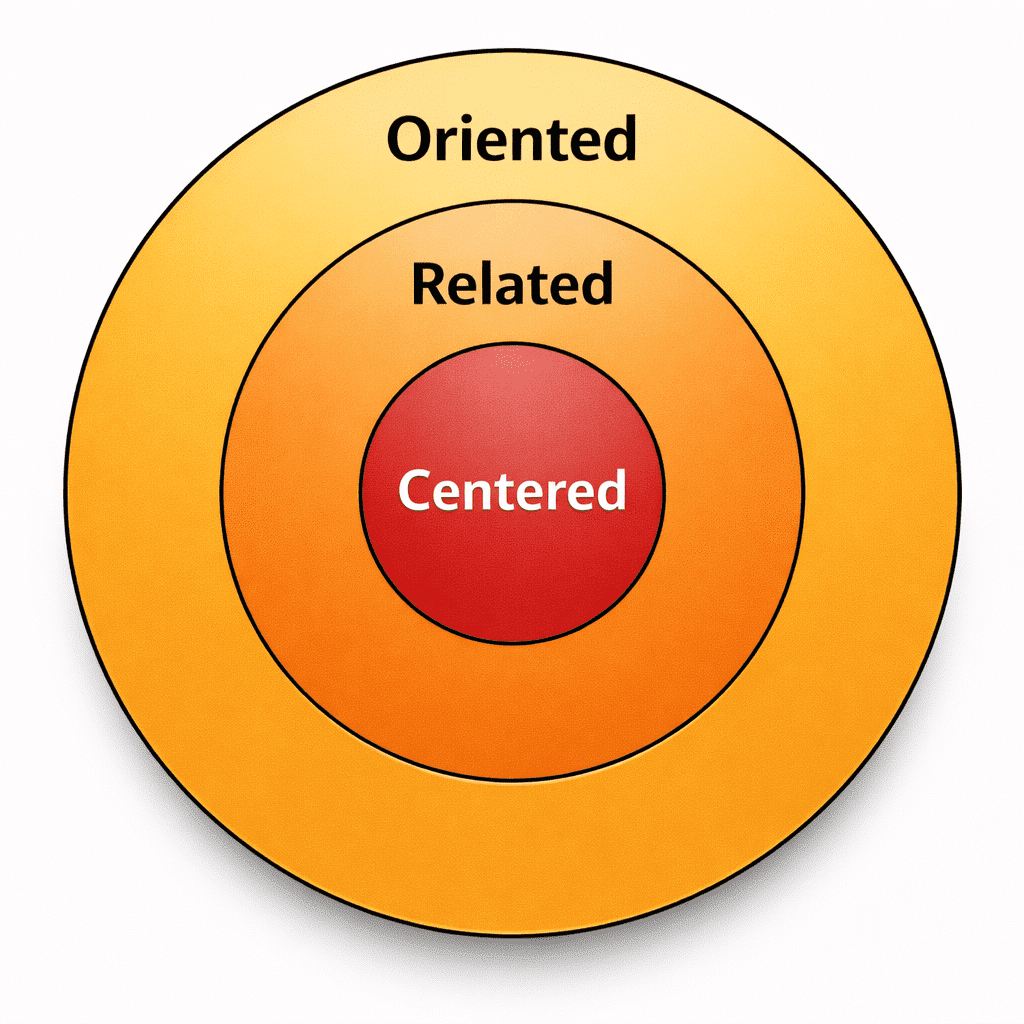
The model maps the market your firm is trying to serve as three concentric rings around the ideal buyer your Fit work has already identified. The metaphor is a bullseye, and the rings name three different placement relationships between your firm and the same buyer.
The buyer doesn’t move across the rings. The buyer sits in one place. What changes across the rings is the surface through which you reach that same buyer. That distinction is the single most important thing to understand about the model. If you’ve ever read The Bullseye Method as a way to slice your audience into types, you’ve read it the wrong way.
The rings are about access, not identity.
One clarification worth naming before the rings themselves. The Bullseye Method is like a dartboard. Picture the bullseye at the center of the board as your ICP, and the three rings around it as the surfaces through which you can reach that buyer.
The reason I prefer the dartboard analogy is because, on a standard bullseye such as one used in archery, the value is a gradient centered on the bull. A miss just drifts into the outer rings as a lesser result.
But a dartboard doesn’t work that way. Its rings aren’t a value gradient. The bullseye scores fifty points, but a triple-twenty out in the scoring rings scores sixty. The board rewards the player who knows where the highest-scoring spots live, not the one who fires only at the bull.
Translate that into positioning. Point everything at the bullseye through the Core surface alone and you’ll often produce less reach to the same ICP than working the Middle or the Outside ring on purpose.
The outer surfaces are usually less contested, more abundant, or already pre-warmed by the discovery zones they carry. The Middle and the Outside aren’t consolation rings. They’re often where your best scoring against the bullseye actually happens.
This is why the FAME pillar that governs targeting is called Aim, not Target. Target says point at the center. Aim says find the highest-leverage spot on the board.
In my original Power Positioning work from 25 years ago, I named this pillar Target, and I taught it like archery. The rewrite of the book renames it Aim, because the discipline of choosing where to release the throw is different from the instruction to point at the middle.
One more update layered on the metaphor.
The Bullseye Method in the early years was about where to spend the limited advertising budget a small business had. The Bullseye Method in 2026 is about where to spend the limited attention a market is willing to give.
Attention is the scarce resource now. The ring discipline is sharper today, not looser, because the cost of getting the targeting wrong has moved from wasted media spend to wasted credibility with an audience that won’t give you a second hearing.
One practical layer worth naming. In 2026 I use AI at the discovery stage of the Bullseye Method to surface the Middle and Outside placement contexts I wouldn’t have thought to look for on my own. The full three-layer method is in the Fortin File.
The Core: audience-centered
The Core is where your audience is most directly reachable. Their home base. The surfaces where you can address the buyer by name, title, or role without a third party in between.
A Core placement is the buyer’s direct email, their LinkedIn profile, the trade show where their badge reads their title, the named account list inside your CRM. The Core is the ring where targeting is structurally direct. You aren’t waiting to be discovered. You’re reaching the buyer in the spaces they occupy professionally as themselves.
The Core is where most teams concentrate their effort, and where most also stay too long. A Core that’s been mined through climbs in cost-per-acquisition because every remaining buyer is harder to reach, slower to decide, or already known to a competitor with a stronger presence inside the same channel.
The Core has to be the anchor of your targeting plan, not the entirety of it.
The Middle: audience-related
The Middle is the placement context related to your audience. Not the buyer’s home base, but the surfaces they pass through, congregate in, or rely on as part of how they operate.
The Middle is the trade association the buyer belongs to. The industry conference they attend each year. The publication they subscribe to. The peer community where they trade notes with people in the same function. The platform or tool they log into to do their job.
The Middle is reached by going where the audience goes rather than addressing them by name. The buyer is the same buyer. The placement is one step removed from direct contact. Your firm has to earn the buyer’s attention inside someone else’s surface rather than command it through a one-to-one channel.
This is the ring most teams underweight, and in most categories I diagnose, it’s the most underpriced placement opportunity available to a firm that’s earned the right to expand. Competitors with weaker products are sponsoring the conferences, contributing to the publications, and showing up in the communities that your Core-saturated audience is already inside.
The Outside: audience-oriented
The Outside is the placement context oriented to your audience by way of identity, interest, and broader circles, even when those circles have nothing directly to do with your category.
The Outside is the alumni network of the buyer’s MBA program. The non-industry publication they read for general business edification. The long-form podcast they listen to on the commute. The award show they aspire to be nominated for. It also runs through the network of people around the buyer. Board members, investors, hiring partners, and the advisors the audience relies on for professional work.
The Outside is the ring most teams misread most completely. It isn’t a low-quality audience. It’s a credibility surface, not a conversion surface. Running direct-response targeting against the Outside, treating it as top-of-funnel to be converted, produces a small trickle of conversions at a cost-per-acquisition that destroys the unit economics.
The Outside is where positioning durability lives. The keynote in front of an audience that isn’t your direct buyer but whose attention your direct buyer respects. The bylined article in a publication the audience reads outside of work. The Outside builds, slowly, the perception layer your Core and Middle eventually run on.
A firm that runs only the Core and the Middle produces conversion in the short term and nothing for the long term. Three years later, the competitor with an Outside presence is winning on perception what the firm without one is trying to win on price.
The buyer isn’t always one person
The rings so far have assumed a single buyer to target. In B2B, and especially in enterprise, the buyer is rarely one person.
The decision usually splits across at least three roles. The executive buyer approves. The financial buyer pays. The user buyer actually uses the product or service. The same purchase requires alignment across all three, and the three often sit in different rings of the placement model.
The user buyer is most often at the Core. They live inside the systems, channels, and surfaces you’ve already mapped. They’re the easiest to reach through direct placements, because their work depends on tools and conversations you already show up in.
The financial buyer often sits in the Middle. The CFO or finance lead encounters vendors through finance-specific publications, peer councils, and industry forums rather than through the user buyer’s surfaces. Target only the user buyer’s home base and you’ll miss the financial buyer entirely.
The executive buyer often sits in the Outside. The CEO or senior leader is reached through the credibility surfaces you’ve built over time. They read business publications, attend leadership conferences, listen to long-form podcasts, follow industry awards. They’re rarely on the direct-response surfaces you use to reach the user buyer.
A complete B2B targeting plan runs all three rings on purpose, with the placement strategy for each ring tuned to the buyer that ring is most likely to reach. The firm that runs only the Core captures the user buyer and stalls when the financial buyer or the executive buyer asks the question the Core surfaces never answered. The firm that runs all three captures the consensus the deal actually requires.
The exception is the smaller deal in a smaller firm, where the three roles collapse into one person, like the owner-operator, the founder, or the leader who has authority over budget and use. In those cases the rings still apply. The same person is being reached through all three for different reasons. The Core reaches them as the role. The Middle reaches them as the professional. The Outside reaches them as the person.
What good research actually surfaces
The most valuable targeting intelligence doesn’t come from a dashboard. It comes from direct conversations with the people who’ve already bought from you.
I push clients to interview their best customers. Not surveys. Conversations. The questions that matter most aren’t “what do you like about our product.” They’re: why did you buy when you did? What were you using before? Where did you first hear about us? What almost stopped you? What would you tell a colleague who was considering us?
Those answers surface both reads at once. The buyer’s situation, motivations, and decision pattern feed the Fit read. The path they took to find you, the surfaces they encountered you on, the names they cite when they describe how they got to your door, all of that feeds the Placement read. A single conversation, done well, sharpens both at the same time.
Robert Collier, the legendary direct-response copywriter, wrote decades ago that the key to great marketing is to enter the conversation already happening in the prospect’s mind. That principle hasn’t aged. It just gets harder to execute when you’re scaling, which is exactly where a fractional CMO earns their keep.
The cost of getting this wrong
Misaligned targeting doesn’t just reduce conversion rates. It distorts every downstream metric in your revenue system.
Cost per acquisition climbs, sales cycles lengthen, and churn rises because the customers you acquired weren’t the right fit to begin with. The team then spends enormous energy optimizing a funnel that’s aimed at the wrong people, on the wrong surfaces, asking the wrong questions.
This is the read I run inside the Investigate stage of my IDEAL diagnostic loop. The loop’s first stage produces the raw material, and the Bullseye Method turns that material into a placement read a team can act on. Skip the ring read and you end up with a pile of data and no answer on where, in the market you’re trying to serve, the audience the data is describing actually lives.
The fix is rarely more spend or more content. It’s a sharper, more honest answer to a deceptively simple question, asked in two parts. Who exactly are we built to close, and where exactly can we reach them.
Get both right, in that order, and almost everything else in the growth system becomes easier to build.
Frequently Asked Questions
Why does audience targeting matter more than the funnel or the price?
Because a well-built funnel aimed at the wrong audience amplifies the wrong result. Price and funnel work compound only when the audience underneath them is right. Get the targeting wrong and every downstream metric — cost per acquisition, sales cycle length, close rate, churn — distorts to compensate. Get the targeting right and the funnel does the work it was designed to do.
What is the difference between Placement and Fit in audience targeting?
Placement asks where the buyer can be reached. Fit asks whether the buyer is worth closing once reached. Placement runs on surfaces (channels, communities, publications, conferences, networks). Fit runs on traits and behavior (company profile, role, situation, decision pattern). The two are separate reads with separate evidence and separate decisions. Treating one as a substitute for the other is the most common targeting mistake I diagnose.
What are the four dimensions of buyer Fit?
Demographics (age, role, industry, company size, revenue, geography), psychographics (motivations, frustrations, buying patterns, beliefs), geographics (urban or remote, local or global), and technographics (technology use, AI adoption, buying-process sophistication). Demographics show who may need your solution. Psychographics show who is motivated to act. Geographics and technographics show what the buyer’s world looks like when the decision gets made. All four feed the Fit read.
How does the Bullseye Method work?
The Bullseye Method maps the market as three concentric rings around your ideal buyer. The Core is where the buyer can be reached directly (email, LinkedIn, trade show, named account list). The Middle is where the buyer congregates through third-party surfaces (associations, conferences, publications, peer communities, industry tools). The Outside is where the buyer forms perception through identity, interest, and broader circles (alumni networks, non-industry publications, podcasts, awards, the advisors and board members around them). Read the model as a dartboard, not an archery target. The outer rings often score higher than the bull.
How does the Bullseye Method work when the buyer is a committee?
In B2B, especially in enterprise, the buyer is rarely one person. The executive buyer approves, the financial buyer pays, and the user buyer actually uses the product. The three roles often sit in different rings. The user buyer is usually at the Core, the financial buyer often in the Middle, and the executive buyer often in the Outside. A complete B2B targeting plan runs all three rings on purpose so the deal captures the consensus it actually requires. The firm that runs only the Core wins the user buyer and stalls when the financial or executive buyer asks the question the Core surfaces never answered.
What is the real cost of targeting the wrong audience?
Misaligned targeting distorts every downstream metric in the revenue system. Cost per acquisition climbs, sales cycles lengthen, and churn rises because the customers acquired were not the right fit to begin with. The team then spends enormous energy optimizing a funnel aimed at the wrong people, on the wrong surfaces, asking the wrong questions. The fix is rarely more spend or more content. It is a sharper answer to two questions asked in order: who exactly are we built to close, and where exactly can we reach them.

Michel Fortin
Michel Fortin is the creator of Power Positioning and a fractional CMO/CGO/CSO who helps growth-stage companies, expert-led firms, and SaaS brands diagnose what's stalling their organic growth and build the systems to fix it. Over 35 years and more than 200 industries, his work has influenced over $3 billion in revenue by combining deep positioning expertise with AI-powered marketing strategy. He's the author of Power Positioning and a recognized thought leader on organic visibility and authority-driven growth. Michel writes the Fortin File™ Newsletter (on Substack), where he shares strategic insights on positioning, AI, and sustainable growth for leaders and consultants.

Flat organic numbers tempt teams to do more of everything. More content, more links, a new agency. Here’s how I find the one constraint behind a stall before anyone spends another dollar on the wrong fix.

One framework will lie to you with total confidence. PULSE is the five-lens read I run before I touch a stalled business, rebuilt for the age of AI search.

When a buyer asks ChatGPT who to hire, the answer names a few firms and skips the rest. Here’s how I help consultancies and other expert-led firms become one of the names AI search cites.