The Context Vault That Makes AI Amplify Your Voice, Not The Average

Michel Fortin
Author

Article Summary
AI cannot represent you if you never gave it enough of you to work with. The output is only as specific as the input. Average in, average out. A Context Vault is a living knowledge base an expert or executive maintains specifically to feed the AI their frameworks, stories, voice, and proprietary thinking, so the output comes back wearing their fingerprints instead of the industry mean. It is built for the model, not for the operator. It is what turns AI from a User’s tool into an Amplifier’s asset, and in a market where the human gap is widening, it is the discipline that decides who compounds and who blends in.
Average in, average out
Someone asked me on LinkedIn today whether the AI-generated writing problem could be fixed by being a better prompter. I answered with a line that takes four words to say what most operators need six paragraphs to say.
Average in, average out.
That’s the whole problem in one sentence. Feed the AI a thin, generic prompt and it hands you back the average of everything it’s ever read on the topic, and the reader can smell the average from three sentences in. Feed the AI enough of you to work with, and the output starts to look like you wrote it, because in a real sense you did.
The gap between those two outputs is what I want to talk about. It’s also why I built what I call a Context Vault, and why I use one every single day.
The human gap
There’s a principle John Naisbitt named in the early 1980s that’s truer now than when he wrote it. The more high-tech we become, the more high-touch we crave. Every generation of technology deepens the appetite for the human layer sitting on top of it. The machine gets better at the generic answer, and the market gets sharper at rewarding the specific human on the other side.
That’s the human gap. And in 2026 it’s widening, not closing, because AI is doing to the current generation exactly what the technology in Naisbitt’s book did to the last one. It generalizes toward the mean and flattens the average, and the buyer, quietly, gets faster at spotting who’s inside that average and who’s outside it.
If you’re an expert whose value is your specific judgment, the widening human gap is the best structural news of your decade. The mean is a commodity. The specific expert isn’t. The problem is that most experts are handing their marketing to AI in a way that forces their voice back into that mean, because the AI has nothing else to work with.
The fix isn’t to swear off the tool. I use it every day. The fix is to feed it your specific self, in a form the model can actually draw on. That form is what a Context Vault is for.
The lawyer, the junior copywriter, and the AI
I ran a copywriting agency for years. I didn’t write every draft myself. I hired junior copywriters to do the research, run first drafts, and pull the pieces together. My fingerprints were on everything, my judgment shaped every deliverable, and my name was on the client relationship. But the junior work was junior work. It was necessary, and it multiplied what I could do.
Lawyers work the same way. A senior lawyer doesn’t do every task on a case. Paralegals run the research, clerks file the paperwork, junior associates draft the first passes. The senior’s fingerprints stay on everything. The judgment stays with the senior. The client hires the senior for the seat, not for the volume of tasks the senior personally performs.
AI is the junior associate now. That’s the model that clicks for me. AI isn’t a replacement for the senior but the newest junior on the team. It runs the first pass and drafts the research. It produces the raw material the senior then edits, revises, and stamps with their fingerprints. The judgment stays where it belongs, and the volume changes.
Every junior needs onboarding, though. A lawyer’s junior associate spends the first months absorbing how the firm thinks. A junior copywriter I hired in the 2000s spent the first weeks reading the archive of everything the agency had ever shipped. Without that onboarding, both would produce work that felt off, because the firm’s voice and judgment lived inside the senior and had never been transferred.
The AI has never worked at your firm, and it never will. It can’t absorb your judgment by hanging around long enough. It only knows what you put in front of it. Put nothing of you in front of it, and it drafts against the industry mean. Put the accumulated shape of your thinking in front of it, and it drafts as though it worked for you.
The Context Vault is the onboarding document for the junior associate you’ll never meet.
What a Context Vault actually is
A Context Vault is a living knowledge base an operator maintains specifically to feed the AI enough of them that the AI’s output comes back wearing their fingerprints. It’s not a folder of files. It’s a corpus. Frameworks, stories, voice notes, positioning canon, IP, points of view, client history, personal narrative, all cross-linked so the model can trace one idea to the next.
The idea comes from two lineages that people often confuse.
The first is Tiago Forte’s “Building a Second Brain.” That’s a productivity system. It’s a way to capture and organize what you take in so you can find it again later. It’s built for the operator’s own retrieval. The audience is the human maintaining it.
The second is newer. In April 2026 Andrej Karpathy described an LLM wiki. A knowledge base kept as plain markdown that the model itself reads and maintains. Add a document and the LLM pulls out what matters, updates the existing pages, revises the summaries, flags contradictions, and tightens the links between ideas. It heals itself through periodic health checks as it grows. The audience is the model.
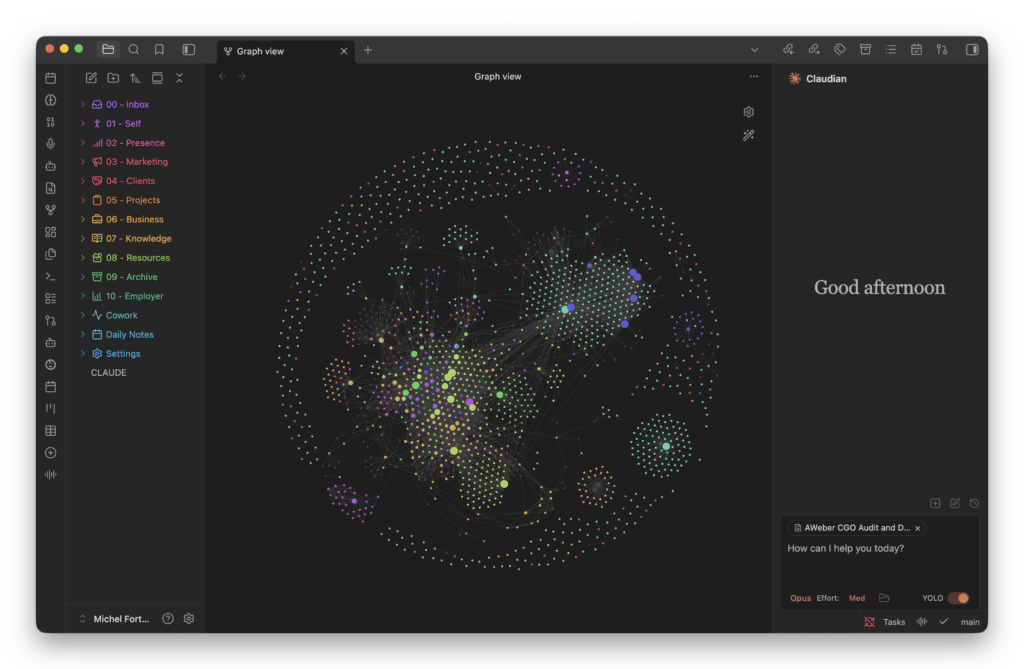
I build mine in Obsidian, and I fold both ideas together into one thing with a different job than either of them had originally. Forte’s version exists to make me more productive. Mine exists to feed the AI. It holds my frameworks, my proprietary thinking, my point of view, my stories, interlinked into a knowledge graph the model can draw from. When the AI writes against that context, the output comes out wearing my fingerprints. The slop has no soil to grow in.
The way Karpathy framed it stuck with me. Obsidian is the IDE. The LLM is the programmer. The wiki is the codebase.
Context Vault 1.0 versus 2.0
The version-numbered distinction helped me get this right, the same pattern that produced EAT 2.0 sitting on top of EAT 1.0.
Context Vault 1.0 is a set of static files and folders. Each file is individualized, standalone, and updated by hand. Adding to the vault means either creating new files, which grows the context you have to feed the AI every time along with the cost, the tokens, the resources, and the time, or manually editing existing files one by one. Version 1.0 is Second Brain territory. It works. Ten times better than an AI with no vault behind it. But it stops scaling the moment your body of thinking outgrows what you can hand-maintain.
Context Vault 2.0 uses a knowledge graph. Ideas connect to each other through nodes and edges. It’s living and breathing, it self-heals, and it ingests content from a central location, the way Karpathy’s LLM wiki does. The files are still there, but the shape of the vault is the network of connections between them. New material comes in and the graph updates itself, rather than waiting for you to slot it into the right folder by hand.
The audience is different too, and that’s why the version numbering earns its distinction. Version 1.0 is built for the operator, with categories organized around retrieval and personal thinking. Version 2.0 is built for the model, with categories organized around what the AI needs to render you accurately when it drafts. Same software, different job, different rules.
The version-two vault is the one that changed what my AI outputs looked like. The day I stopped keeping a folder of static files and started building a self-healing graph the AI could traverse, the drafts started carrying my fingerprints instead of the industry mean.
You can run a 1.0 vault and a 2.0 vault side by side. In practice most operators end up folding them together in one system with clearly separated purposes. The important move is knowing which layer you’re writing in when you write. If the file exists to help you retrieve, it’s 1.0. If the file exists to help the AI represent you, it’s 2.0. The moment that distinction gets sharp, everything downstream gets sharper too.
What sits inside mine
Let me walk through the shape of the actual thing rather than the abstract description. Different vaults will look different, and that’s exactly right. The categories translate.
My frameworks. FAME, OATH, QUEST, FORCEPS, IDEAL, CASE, the Bullseye Method, the Ketchup Principle, the Unconscious Parallel Assumption, EAT 2.0. Each gets a page with the definition, the origin, the shape of the argument, and standard applications. If the AI drafts against one of these, it uses the name correctly and applies the framework the way I’d apply it.
My Story Bank. The signature stories I use across content, sales conversations, and speaking. The bankruptcy at 23. The $1M day in 2004. The 1,628% rebrand. The Copywriters Board. The 924% lift in AI-search sessions at Consulting Success. Each one written with the metric, the lesson, and the frameworks it illustrates. If the AI is drafting something that would benefit from proof, it reaches for the right story instead of a generic reference to “one of my clients.”
My Voice Fingerprint. Explicit specifications of how I write and how I don’t. Sentence rhythm. Paragraph length. What I say (“Diagnose. Architect. Scale.” “First in the mind, not first in the market.”) and what I refuse to say (delve, tapestry, testament, pivotal). Voice is the part AI tends to flatten first, so this is the part the vault has to guard hardest.
My positioning canon. The tagline, the audiences, the framework hierarchies, the brand line, the through-line. This is where “Diagnose. Architect. Scale.” lives, next to why it exists, next to how it relates to Power Positioning. So the AI never wanders off-position.
Client and career history. Enough context that when I need to reference “the SaaS platform I helped hit a plateau breakthrough,” the AI knows I mean Musora and knows the metric (244% traffic YoY) and knows the frame (diagnose before act).
Personal narrative. ADHD diagnosed at 52. RSD as the reason cold prospecting never worked. The four sales jobs that failed. The Thoreau quote at 16. Why authority-led inbound was a survival mechanism before it was a strategy. This is where the AI stops sounding like a strategy consultant and starts sounding like me.
The vault isn’t exhaustive and it isn’t finished. It’s a living asset. I add to it every week.
What changes when the AI has it
The most immediate change? The output starts to feel like mine on the first pass. Not a rewrite job. Not a polish pass. Actually mine. The first draft is close enough that my editing is trimming and sharpening, not rebuilding from scratch. That’s a compounding time-savings that shows up in output volume before it shows up in anything else.
Beyond speed, five things start to happen.
Voice consistency lands across surfaces I never sat down to write. LinkedIn posts, blog headers, cover letters, meta descriptions, speaker bios, all drafted in an afternoon, all sounding like me. The reader who sees three of them in a week gets the impression that I published three pieces, not that a machine produced three lightly personalized artifacts.
The AI fabricates less often, because the source is right there. When I ask for a proof point, it reaches for the story I actually have rather than inventing something plausible. The vault is a fact-checker as much as a voice model.
Discovery-layer visibility compounds. Content that carries specific named frameworks and specific stories gets cited by AI search engines instead of paraphrased. This is the mechanism underneath the 924% AI search lift I ran at Consulting Success. The AI writing the answer for the searcher reaches for content it can attribute. Generic content gets paraphrased and the source link gets dropped. Content with fingerprints gets cited by name. The Context Vault is what puts fingerprints on every piece.
Delegation runs without loss. I can send the AI to draft against my vault and the output represents me. The lawyer stays the lawyer, the senior copywriter stays the senior copywriter, and the junior does the volume while the senior does the judgment. Nothing about that model changes when the junior is a machine.
And finally, the market can tell. The buyer who reads my content can’t always articulate why it feels different, but the thin-slicing goes the right way instead of the wrong way. That’s EAT 2.0 in action. The Empathy, Authenticity, and Transparency layer that AI can’t fake stays intact because I never asked the AI to produce it. I asked the AI to help me multiply it.
How to build one
There’s a seven-step teaching arc I use with clients, and it works because it starts with the foundation and then the highest-leverage layer, and moves outward. Do it in order.
Start with your About file. Who you are, background, credentials, clients, projects, ICP, business, channels, products, services. The onboarding document for a new employee, applied to a machine that will never take you to lunch. This is the background file on you, and your business or organization.
Add your AI operating notes (preferences). It’s the way you want to work with AI. What you want from it, what weaknesses you want it to compensate for, what you refuse to let it produce, and your personal tastes. This is the file that turns the AI from generically helpful into specifically useful to you.
Describe your frameworks. If you’ve coined vocabulary, methodology, or repeatable models, they belong in the vault before the rest. Write each on its own page. Definition, origin, standard applications. This is the layer that fingerprints every piece of downstream content, so it earns first attention.
Add your stories. Not everything you’ve done but the ones you actually use. For example, the signature moments, the client wins, the failures with lessons. Each gets a page with the metric, the setting, and the takeaway. This is what stops the AI from reaching for generic proof.
Version your voice. Write an explicit voice fingerprint that names the sentences you use and the sentences you refuse, the rhythms you like and the cadences you avoid, and the words that read like you against the ones that don’t. This is the file that guards against the AI drifting toward the industry mean.
Cross-link everything. The vault isn’t a folder. It’s a graph. When the AI reads one page, the surrounding pages become part of the context. If FAME references OATH, the AI reading FAME picks up OATH too, and the output stays coherent across the whole framework family instead of naming one and dropping the others.
Feed the vault back to itself. Every new piece you ship, every talk you give, every client engagement worth documenting becomes a source for the next round of drafting. The vault gets denser over time, and the AI’s output gets sharper alongside it. This is where the compounding lives.
You don’t need a specific tool to do this. Some people use Notion while others use Roam Research. I use Obsidian because plain markdown holds up across every AI I might work with, and because the graph view is instructive. Any system that stores plain text and links between files will work. The vault is the discipline, not the software.
What it is not
A Context Vault isn’t a team knowledge management system. Team KM is about giving the team a shared source of truth. The Context Vault is a personal or firm-level asset built for the AI to draw from. The overlap is real, but the purpose is different.
It isn’t automation. The vault doesn’t send emails, publish posts, or run workflows. It’s context, not action.
It isn’t a substitute for judgment. The AI drafting against a vault still needs a human deciding whether the draft is right, whether the argument holds, whether the piece should ship at all. The junior does the work, and the senior does the decision. That relationship doesn’t change.
And it isn’t a Second Brain. This one matters most, because the two systems look similar from the outside and produce very different results. A Second Brain is built for your retrieval. A Context Vault is built for the model’s retrieval. The categories, the density, and the writing style are all different because the audience is different. Try to run one thing for both jobs and you get a slightly worse version of both.
The strategic frame
Everything above is operational. Here’s why it also happens to be a positioning move.
When you feed the AI your specific self, three things happen in the market.
The AI writes in your voice. Which means the market can’t mistake you for AI, because your content carries something the model on its own wouldn’t have produced. And the market can’t mistake the AI for you, because the fingerprints only exist inside the vault the AI has to draw from.
The human gap widens. The mean gets meaner as more operators outsource their voice to raw AI. Your specific self, amplified by the AI drafting against your vault, moves further from the mean, not closer to it. Naisbitt’s principle applied to language.
And your discovery layer gets clean. The AI engines that now sit between you and the searching buyer prefer content they can attribute by name. Fingerprinted content gets cited. Averaged content gets paraphrased away. The Context Vault is what puts your name in the citation column instead of the paraphrased-away column.
The instinct behind all of this isn’t “AI is powerful, use it more.” It’s “AI amplifies whatever you feed it. Feed it the specific you, not the generic mean.” That’s the difference between an AI User, who prompts and pastes, and an AI Amplifier, who has built the asset that makes the amplification specific.
I promised in the ketchup principle piece that I’d write this. The reason I’m writing it now is that in the time since I first built mine, the operators who moved earliest on this got the largest compounding return. Every quarter you spend without one is a quarter of thinning fingerprints in your output. The market is learning to grade for fingerprints faster than you might think.
Average in, average out.
Or, alternatively, you in, you out.
Choose which one your marketing represents.
Frequently Asked Questions
What is a Context Vault?
A Context Vault is a living knowledge base an operator maintains specifically to feed the AI enough of them that the output comes back wearing their fingerprints. It holds frameworks, stories, voice notes, positioning canon, IP, client history, and personal narrative. It is a corpus built for the model to draw from, not for the operator’s own retrieval. The purpose is to make the AI represent the specific expert instead of the industry mean.
How is a Context Vault different from Building a Second Brain?
Tiago Forte’s Building a Second Brain is a productivity system built for the operator’s own retrieval. That is Context Vault 1.0 territory, a knowledge base written for the human maintaining it. Context Vault 2.0 flips the audience. It is built for the AI’s retrieval, not the operator’s. The categories, density, and writing style all differ because the audience differs. A Second Brain is optimized for the human maintaining it. A Context Vault 2.0 is optimized for the model reading it. Same software, different job, different rules.
What does “average in, average out” mean for AI content?
If you feed the AI a thin, generic prompt, it returns the average of everything it has been trained on. That average is the mean of the internet on the topic, which the market has learned to spot within a few sentences. If you feed the AI enough of your specific thinking, the output comes back at the level of that thinking. The context you provide is the ceiling on what the AI can produce for you. Context in, context out. Average in, average out.
Do I need Obsidian to build a Context Vault?
No. I use Obsidian because plain markdown holds up across every AI I might work with, and because the graph view helps me see connections between frameworks and stories. Any system that stores plain text and links between files will work. Notion, Roam, Logseq, a folder of markdown files. The vault is the discipline of writing your frameworks, stories, voice, and positioning down in a structured way. The software is secondary.
Does a Context Vault make AI content sound less like AI?
Yes, and for a specific reason. AI without context defaults to the industry mean, which readers have gotten faster at recognizing every month. Content drafted against a Context Vault carries the operator’s specific frameworks, stories, and voice. It reads as fingerprinted rather than averaged. The AI is not less AI. It is drafting for a specific expert instead of drafting for the mean.

Michel Fortin
Michel Fortin is the creator of Power Positioning and a fractional CMO/CGO/CSO who helps growth-stage companies, expert-led firms, and SaaS brands diagnose what's stalling their organic growth and build the systems to fix it. Over 35 years and more than 200 industries, his work has influenced over $3 billion in revenue by combining deep positioning expertise with AI-powered marketing strategy. He's the author of Power Positioning and a recognized thought leader on organic visibility and authority-driven growth. Michel writes the Fortin File™ Newsletter (on Substack), where he shares strategic insights on positioning, AI, and sustainable growth for leaders and consultants.

When buyers ask AI to recommend a consultant, who gets named? I ran 468 answers across five AI engines to find out. The big names win in strategy, and the firms that break through publish the pages AI cites.

When I asked ChatGPT about my own method, it named me. When I asked the same buyer question without my method’s name, it named four other people. Here’s what that gap taught me.

Flat organic numbers tempt teams to do more of everything. More content, more links, a new agency. Here’s how I find the one constraint behind a stall before anyone spends another dollar on the wrong fix.