
Why Expert-Led Companies Need AI to Amplify Their Marketing (Not Replace It)

Michel Fortin
Author

Article Summary
AI amplifies the foundation it’s built on, so companies with weak positioning scale mediocrity faster. For expert-led firms, the right approach uses AI across four interconnected areas: sales intelligence, authority building, delivery excellence, and business intelligence. Central to this is a “Context Vault” that teaches AI the firm’s methodology and quality standards, allowing expertise to scale without losing distinctiveness.
Most of the AI-generated marketing I come across reads like it came from the same machine, because it did. Someone typed a prompt, got a blog post back, and hit publish. It’s fast, and it’s interchangeable with every other post on the topic.
I’ve been folding AI into real marketing work, mine and my clients’, since I started using these tools. What I’ve learned is that AI doesn’t replace expertise. It amplifies whatever you feed it, and that distinction matters more than most marketers realize.
The AI Amplification Problem
AI amplifies whatever foundation you build it on. If your positioning is fuzzy, AI will produce fuzzy content faster. If your messaging is generic, AI will scale that mediocrity across every channel.
I see this pattern constantly. Expert-led companies with genuine authority in their space are producing AI-generated marketing that sounds exactly like their competitors. They’ve adopted the tools without building the strategic foundation those tools need to actually work.
The result is more content with less impact. Teams publish more, get fewer qualified leads, and add to the noise. That’s the amplification problem.
What “AI-Amplified” Actually Means
When I talk about AI amplification, I’m not talking about using ChatGPT to write blog posts. I mean building AI into four connected areas of your marketing operation, so your actual expertise reaches the people who need it.
The first is sales intelligence and business development. AI speeds up prospect research, competitive analysis, and proposal customization, so you walk into every conversation prepared. That matters for expert-led firms, because your credibility depends on understanding the prospect’s world before they hire you.
The second, marketing and authority building, is where most companies start and where most go wrong. Volume isn’t the goal. The goal is content that pulls several sources into insights nobody else has, shows pattern recognition your competitors can’t match, and positions you for both traditional search and AI discovery.
Delivery is the third. When AI is part of how you actually deliver the work, research gets faster and analysis goes deeper, and clients feel the difference directly. That supports premium pricing and earns referrals.
The fourth is operations and business intelligence. AI can surface patterns in your pipeline, client satisfaction data, and market position that would take weeks to find by hand, and those insights feed the other three.
Companies that treat AI as a content shortcut miss all four. They get one area, done poorly.
Why This Matters More for Expert-Led Companies
If your business is built on thought leadership, niche expertise, or professional authority, you have something most companies don’t: genuine credibility. People trust your insights because you’ve earned that trust through years of deep work. AI can multiply that trust at scale. But only if the amplification preserves what makes your expertise distinctive.
I use a concept I call a Context Vault to solve this problem. It’s a systematized approach to providing AI with the background knowledge it needs to function as your strategic partner, not a generic content generator. When AI understands your methodology, your client types, your quality standards, and your unique perspective, the outputs stop sounding like they came from a machine and start sounding like they came from an expert with decades of pattern recognition.
The idea didn’t start with AI. I have ADHD, and I’ve always needed a base to work from. It’s the same reason most of my frameworks started as mnemonics. Long before ChatGPT, I kept a second brain using Tiago Forte’s method, mostly so I could find my own thinking again.
When AI arrived, I uploaded those files so the model had something to work from. Around the same time, two things landed. Tiago Forte and Hayden Miyamoto released their master prompt method, which hands the AI your background as a separate file before you give it a task. And at Consulting Success, the team started building a “lore” folder, inspired by Tom Bilyeu’s videos. Different names, same instinct. Give the AI the backstory first.
It worked until it didn’t. As the files piled up, the AI started losing track of what mattered and drifting away from my thinking, so I moved everything into NotebookLM to keep it manageable. That held for a while. Then I found Obsidian and Andrej Karpathy’s LLM wiki idea, which sent me down the rabbit hole that became what I now call Context Vault 2.0. I built it on Nick Milo’s Linking Your Thinking approach and adapted it to my own work and my clients’.
The expertise in the output is still mine. The vault is how the AI gets access to it.
Where Branding Fits in AI-Amplified Marketing
Branding is the growth driver I see skipped most often in AI-amplified visibility.
The companies winning in AI-powered search aren’t just visible. They’re distinctively visible. Their brand carries three signals that AI systems increasingly reward: awareness, authority, and affinity.
Awareness isn’t just about getting seen. It’s about being known for what makes you unique. Authority positions your brand above competitors in your audience’s mind. AI search engines amplify this because they’re synthesizing and recommending sources, not just listing them. If AI trusts your brand as authoritative, you become the answer, not one of ten blue links.
Affinity is the emotional layer. When your audience doesn’t just know you and trust you, but likes you and identifies with you, they become evangelists. AI can’t manufacture affinity. But it can amplify the signals that create it through consistent voice, authentic storytelling, and personalized engagement at scale.
Most AI marketing strategies skip branding entirely and jump straight to content production.
How I Build AI-Amplified Marketing Systems
I don’t drop in a tool stack and walk away. I build marketing systems where AI amplifies your existing strengths rather than replacing them with generic alternatives.
Positioning-first content strategy. Before any AI touches your marketing, I audit your positioning. If the foundation is unclear, AI will scale confusion. I use my OATH framework to map where your audience sits on the awareness spectrum, then build content strategies that speak to each stage with your voice and your insights. AI makes it possible to create that stage-specific content at scale. But only if you’ve mapped the stages first.
Context engineering for your brand. I build your Context Vault: a comprehensive brief that transforms generic AI into domain-specific expertise. This includes your methodology, your client profiles, your differentiators, and your quality standards. Once this foundation is in place, every AI-assisted output carries your authority and sounds like you.
Professional-grade prompting systems. Most teams prompt AI the way they’d ask a colleague a question in the hallway, and they get hallway-quality answers. I use a prompting framework called CASE (Context, Action, Specifications, Expectations; formerly RACES), which turns every prompt into a proper brief, the same kind I used to hand my junior copywriters.
Semantic content architecture. Traditional SEO focused on keywords. AI search goes further. It understands how concepts relate, weighs topical authority, and pulls answers from the sources it trusts most. So I build content around topics and entities, with clusters and internal links that show both people and AI how your ideas connect. I ran that playbook at Musora, where a shift to user-first, entity-based SEO helped lift traffic 244% year over year.
AI-optimized visibility. AI-powered search engines like Google’s AI Overviews, ChatGPT, and Perplexity are changing how expert content gets found, and most marketing teams haven’t adapted. At Consulting Success, I didn’t start from zero. The founder, Michael Zipursky, had spent years building a library of more than 1,200 articles, plus books, podcasts, and frameworks. I led the rewrite of 100 core articles on top of that foundation, restructured them for AI retrieval, and added schema. Sessions from AI search grew 924% year over year, pageviews grew 859%, and AI-generated SQLs rose 23.53% quarter over quarter, outperforming every other channel. New leads also started telling sales they’d found the firm through ChatGPT and Gemini.
Human oversight at every stage. AI generates and humans validate. I don’t publish AI-assisted content without expert review, and I build review steps into every system so your team keeps quality control without creating bottlenecks.
Why I’m Not Waiting This One Out
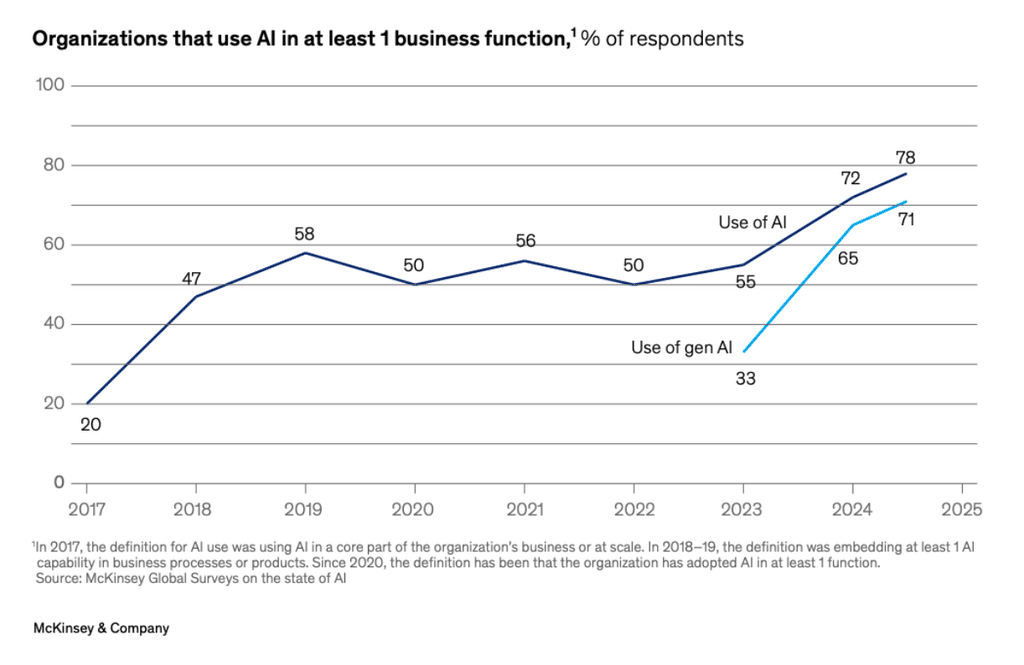
Communications media keep spreading faster. Newspapers took generations to reach most homes. Radio took decades, and the internet took years. Generative AI is moving faster still. A St. Louis Fed study found that, counting from each technology’s first mass-market launch, people have adopted it faster than either the PC or the internet. Businesses are moving just as quickly. McKinsey’s State of AI survey found the share of organizations using generative AI jumped from 33% in 2023 to 71% by early 2025.
I’ve watched a shift like this before. For years, companies clung to keyword-stuffing while the algorithms evolved around them. The ones that moved early to topical authority and user-first content took positions that keyword-focused competitors still haven’t won back.
AI-powered discovery feels like the same kind of shift, only faster. The expert-led companies that build AI-amplified marketing systems now will have an advantage that compounds. Anyone who waits will spend years catching up to competitors who moved while they debated.
How I wrote this: based on my own experience and client work. I used AI to help organize and tighten the draft, then edited and fact-checked it myself.
Frequently Asked Questions
What’s the difference between AI-amplified marketing and AI-replaced marketing?
AI-replaced marketing treats AI as a content factory. Plug in a prompt, get a blog post, publish and hope. AI-amplified marketing uses AI to scale what’s already distinctive: your methodology, your voice, your expertise. The difference in output is obvious. One sounds like everything else. The other sounds like you.
What is a Context Vault and why does it matter?
A Context Vault is a systematized brief that teaches AI your methodology, client profiles, quality standards, and unique perspective before it generates anything. Without it, AI defaults to generic. With it, every output carries the authority of someone with decades of domain expertise, because it does. The expertise is yours. AI just makes it scale.
What four areas does AI-amplified marketing actually cover?
The four interconnected areas are sales intelligence (prospect research and proposal customization), authority building (content that demonstrates genuine pattern recognition, not just volume), delivery excellence (AI-assisted research and analysis that improves client outcomes), and business intelligence (analytics that surface pipeline and market patterns faster than manual review). Most companies only attempt the second area, and do it poorly.
Why does branding matter so much in an AI search environment?
AI search engines don’t just list results. They synthesize and recommend sources. If AI systems recognize your brand as authoritative, you become the answer, not one of ten options. That requires three signals: awareness (known for what makes you distinctive), authority (trusted above competitors in your niche), and affinity (an audience that identifies with you). You can’t manufacture any of these with content volume alone.
What results has AI-amplified marketing actually produced?
At Consulting Success, I led the rewrite of 100 core articles inside the founder’s existing library of more than 1,200, restructured for both traditional and AI search. Sessions from AI search grew 924% year over year, pageviews grew 859%, and AI-generated sales-qualified conversions rose 23.53% quarter over quarter, outperforming every other channel. The strategy started with positioning, with AI amplifying a foundation of topical authority that was already there.

Michel Fortin
Michel Fortin is the creator of Power Positioning and a fractional CMO/CGO/CSO who helps growth-stage companies, expert-led firms, and SaaS brands diagnose what's stalling their organic growth and build the systems to fix it. Over 35 years and more than 200 industries, his work has influenced over $3 billion in revenue by combining deep positioning expertise with AI-powered marketing strategy. He's the author of Power Positioning and a recognized thought leader on organic visibility and authority-driven growth. Michel writes the Fortin File™ Newsletter (on Substack), where he shares strategic insights on positioning, AI, and sustainable growth for leaders and consultants.

Most AI output sounds generic because the brief was generic. CASE is the four-part brief I use so AI works from my frameworks, my standards, and my voice instead of the average.

Article Summary An AI visibility audit measures whether AI assistants name a firm when buyers ask for help, which sources they cite to justify it,…

Wikidata had five Michel Fortins before I added mine. An actor, a mathematician, a politician, an archeologist, a dentist. AI can’t recommend a name it can’t place. Here’s how I fixed that, and what it taught me about brand memory.